
I had a chief of staff who I was lucky to work with for a year named Kimberly.
She was the chief of staff to the CEO of a Fortune 500 company.
I met her backstage speaking at a large event for that company. Turns out her CEO was retiring, and working with somebody like me was a dream transition job.
Kimberly’s greatest gift: she was a master question asker. And she illuminated something I’d experienced my whole life:
There are three types of questions you can ask that actually make a difference. They have the ability to change what happens next.
In this video and text summary, I’m going to give you what I believe are three way better conversation starters that could replace most icebreakers. Especially for intact teams who already know each other fairly well.
The 3 Types of Questions Explained
There are three levels:
🟪 1) Possibility questions
Questions about purpose, values, and possibilities.
What is possible? This is the vision layer. The “why.” The big aim.
🟦 2) Process questions
Questions about methods, habits, and process.
The “how” layer. How do you actually get there?
🟩 3) Practical questions
Questions about experiences and actions.
Kimberly was amazing at the action layer. I’d share a vision, and she’d say:
“That’s amazing. By when would you like to have that done?”
Now let me give you a simple walk-through that moves someone from possibility → process → practical.
Starting With Possibility (Vision First)
At the possibility level, you’re pulling for someone’s larger aim. It doesn’t need to be hyper-specific. You’re basically asking:
“What do you want?”
Here’s a possibility question I love:
- If you could solve one problem in the world, what would it be?
I picture these three levels like a spiral: you start in the land of possibility then you move down into how, then into action.
Because when we skip vision and go straight to practical, we get a bunch of activity that leads nowhere. Practical questions without vision create motion… but not direction.
Move To Process (The “How”)
Once someone names a possibility, you get curious about the way they want to move toward it.
For example:
- What brings you joy?
Now you can invite someone to creatively combine the problem they want to solve with what brings them joy. This unlocks a new, previously hidden, future.
That’s where things start to get real.
Then Get Practical (Tiny Actions + Timelines)
A mentor of mine, Laurie Mulvey, used to say that “a tiny act can have profound effects.
And Matt Church is famous in my mind for saying that “action precedes clarity.”
Now it’s time to land the plane.
- By when would you like to have that done?
- What’s the tiniest action you might want to take in the next week to make that happen?
Possibility gives direction. Process illuminates a path. Practical starts the traction.
Questions are the Edit Button to the Future
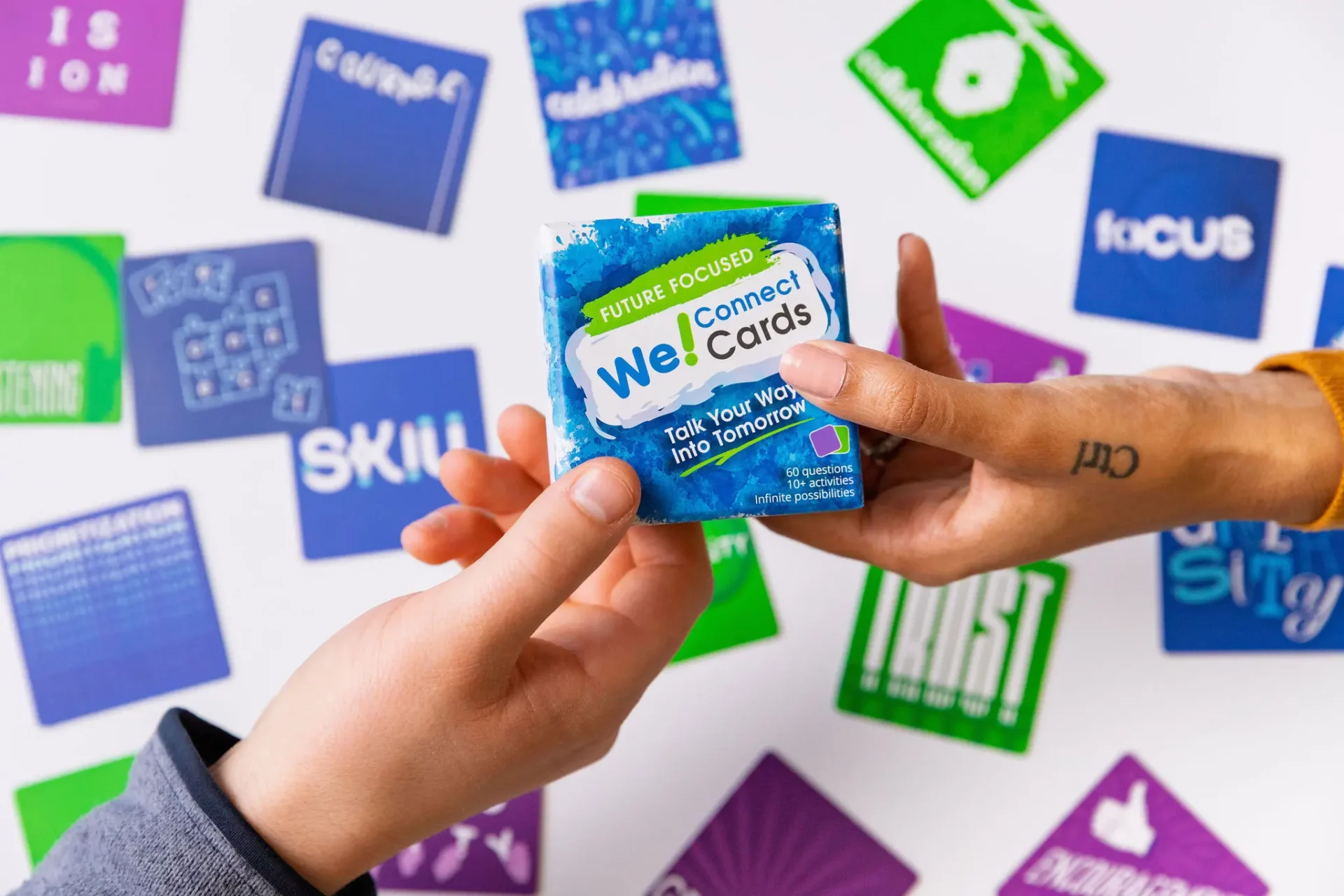
I got so on about this idea—that questions are the edit button to the future that I spent a whole heap of time packing 60 possibility, process, and practical questions into what I think is the coolest tool to replace most other icebreakers, team builders and conversation starters:
- Future-Focused We! Connect Cards: a deck designed to help people talk their way into a more compelling, interesting tomorrow. Launching on February 24, 2025.
The Simple Takeaway Formula
When you’re in a group, start with a possibility question, then add a process question, then end with a practical question.
If you want conversations that actually go somewhere that’s your formula.
One.
Two.
Three.
Have an awesome day.